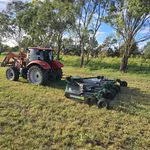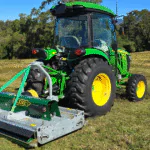
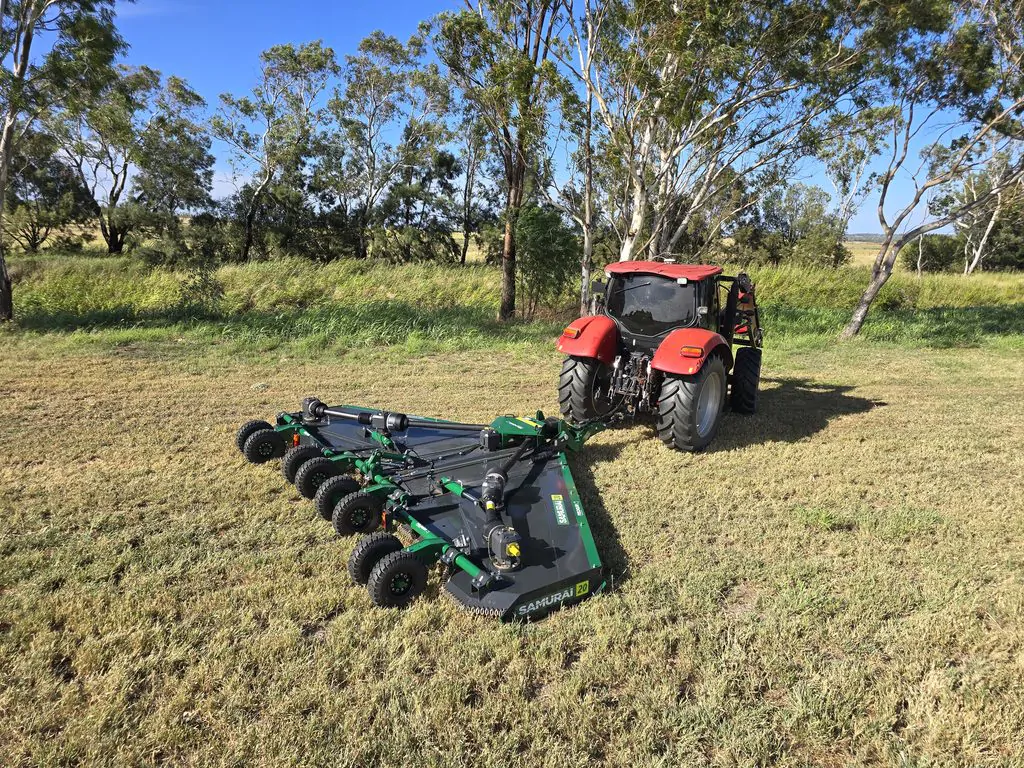
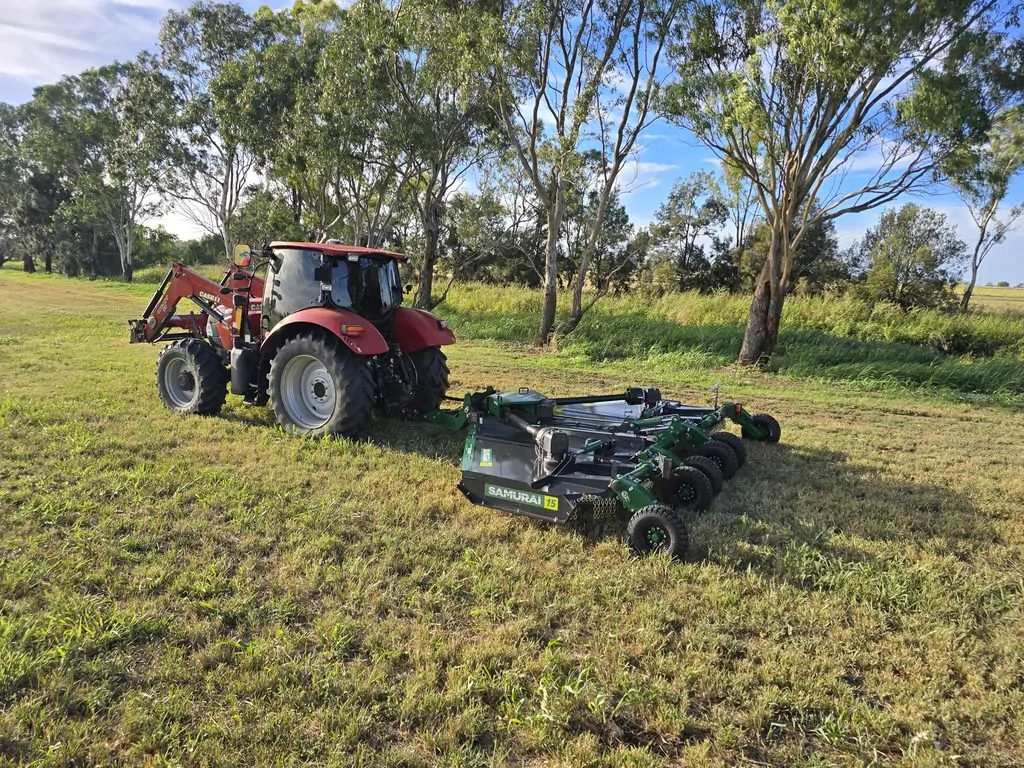
If you’ve searched for a flex wing slasher in Australia recently, you’ve probably landed on a wall of near-identical machines: heavy steel decks, big blades, and a “call for pricing” button. Woods, AusCut, Schulte — they all promise the same thing, and most won’t tell you what it costs until you’ve handed over your details.
The Fieldquip Samurai range is built around a different question: how much slasher do you actually need to get a clean, even cut across a full paddock, without buying (and running) more tractor than you have — and what does that actually cost? The Samurai 15 and Samurai 20 are engineered to cover serious ground on mid-range horsepower, published at a transparent RRP, with a deck design that also solves a problem most flex wing slashers don’t even try to address: weed seed spreading from paddock to paddock.
Samurai 15 and Samurai 20: the specs
| Spec | Samurai 15 | Samurai 20 |
|---|---|---|
| Working width | 4.79m (15’9″) | 6.47m (21’3″) |
| Cutting width | 4.6m | 6.47m |
| Spindles | Triple spindle | 5 spindle |
| PTO speed | 540rpm | 1000rpm |
| Minimum tractor HP | 70hp | 100hp |
| Cutting capacity | 100mm diameter | 100mm diameter |
| Weight | 2,445kg | 3,100kg |
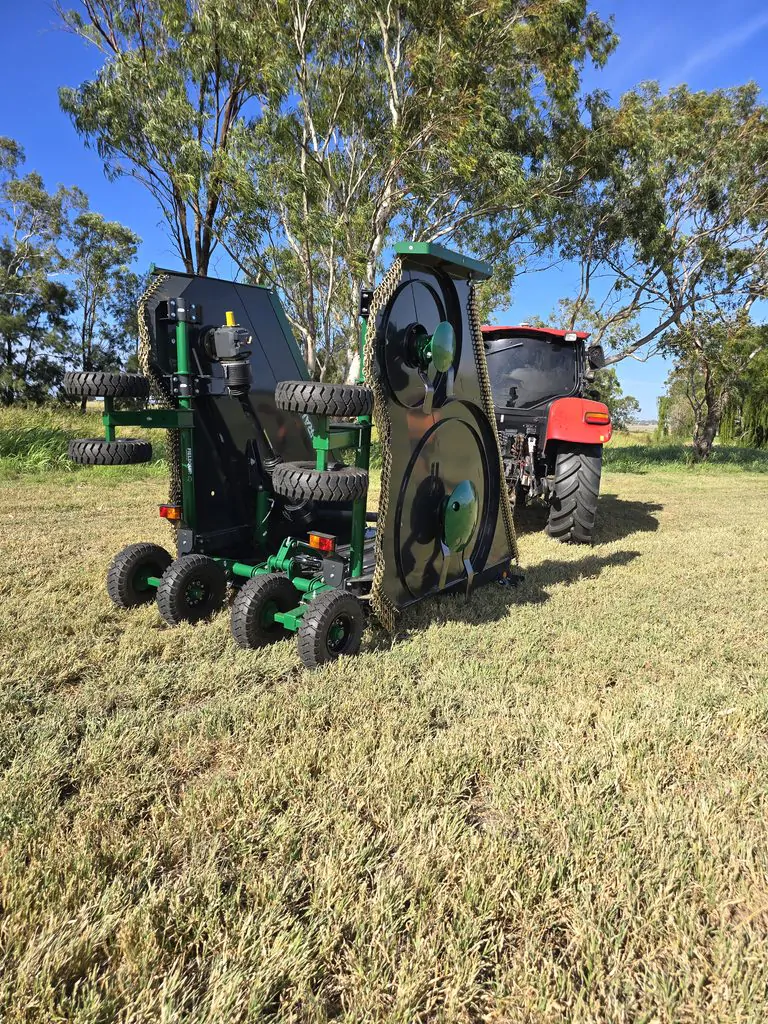
| Transport width | 2.7m | 2.7m |
Both machines fold down to a 2.7m transport width, so moving between paddocks or down a road doesn’t need a pilot vehicle or a permit headache. The gap between them is really a gap in scale: the Samurai 15 is a triple-spindle machine that gets serious pasture and paddock topping done on a 70hp tractor, while the Samurai 20’s 5-spindle deck and 1000rpm PTO are built for operations running 100hp-plus tractors that need to cover more hectares per hour.
Samurai 15 and Samurai 20 pricing
Prices below are current as of 25 August 2026.
| Model | RRP (ex GST) | RRP (inc GST) |
|---|---|---|
| Samurai 15 | $61,198 | $67,318 |
| Samurai 20 | $77,008 | $84,709 |
Full price sheets: Samurai 15 price page (PDF) and Samurai 20 price page (PDF).
That’s the real advantage most competitor comparisons skip entirely: a published number. Woods, AusCut, and Schulte all list specs publicly but keep pricing behind a dealer enquiry, which means every buyer starts their decision without knowing whether the machine is even in their budget. Fieldquip publishes RRP for both Samurai models up front, so you can weigh horsepower requirements, cutting width, and cost together before you ever pick up the phone.
Prices and specifications are RRP as of 25 August 2026 and may change without notice; photos may include optional equipment not part of standard pricing. Confirm current pricing with Fieldquip before purchase.
Why the deck design matters more than the spec sheet
Every flex wing slasher on the market will tell you about high-lift blades and heavy-duty decks. Fewer talk about what happens to the material after it’s cut — and that’s where the Samurai range earns its keep. The flat-top and flat-underside deck is designed specifically to stop debris and grass seed from building up inside the housing and being carried from one paddock to the next.
For anyone managing pasture across multiple blocks, that’s not a minor feature. Seed carryover is how weeds move around a property, and it’s a cost most slasher comparisons ignore entirely because it doesn’t show up on a spec sheet next to cutting diameter. It shows up eighteen months later as a weed problem in a paddock that never had one.
Fieldquip’s engineering brief for the Samurai range is straightforward: deliver a fine, semi-mulching cut without demanding the horsepower that comparable flex wing slashers ask for. That’s the practical payoff of the high-lift blade system and deck geometry working together — a cleaner cut, at a lower fuel and horsepower cost, with less material clinging to the machine between jobs.
How the Samurai range compares to other flex wing slashers in Australia
The flex wing category in Australia is dominated by a handful of brands, and each has carved out a slightly different niche:
(Fieldquip is also proud to stock the Spearhead Multicut range for broadacre pasture and stubble work — see our full flex wing slasher range to find the right fit across both lines.)
| Brand / model | Positioning | Cutting capacity |
|---|---|---|
| Woods Batwing | Premier heavy-duty choice, 12ft-20ft, independent wheel suspension, foam-filled tyres | Up to 115mm |
| Fieldquip Samurai | High-capacity pasture mower, multi-spindle, flat-top deck to prevent seed carryover | 100mm |
| AusCut AlphaCut / XH AlphaCut | Locally manufactured, extra heavy-duty, council roadside and crop residue focus | Varies by model |
| Schulte FX-318 | 18ft cutter running on similar horsepower to standard 15ft units | Varies by model |
Where Woods Batwing and AusCut lean into maximum cutting diameter and heavy-duty roadside or crop-residue work, the Samurai range is built for a different job: high-capacity pasture and paddock topping where horsepower efficiency, transport width, and paddock-to-paddock hygiene matter as much as raw cutting capacity. If you’re clearing heavy scrub or thick regrowth over 100mm, a Batwing-class machine earns its higher horsepower demand. If you’re topping pasture, managing paddock rotation, and want a flex wing slasher that won’t out-muscle your tractor, the Samurai 15 or 20 is the more efficient tool for the job.
Which one — Samurai 15 or Samurai 20?
As a rule of thumb: if your tractor sits in the 70-90hp range, or you’re covering paddocks up to roughly medium scale, the Samurai 15 matches your horsepower without leaving capacity on the table. If you’re running 100hp or more and want to cut hectares per hour rather than hectares per day, the Samurai 20‘s extra 1.68m of working width and 5-spindle deck will make the bigger difference to your day than any other single upgrade.
Frequently asked questions
What tractor horsepower do I need for a flex wing slasher?
It depends on the model. The Fieldquip Samurai 15 needs a minimum of 70hp, and the Samurai 20 needs a minimum of 100hp — both lower than many flex wing slashers of comparable width, because of the machines’ lighter high-lift blade and deck design.
How wide is a 15ft vs a 20ft flex wing slasher?
The Samurai 15 has a 4.6m cutting width (4.79m working width), and the Samurai 20 has a 6.47m cutting and working width. Both fold to a 2.7m transport width for road travel between paddocks.
What’s the cutting capacity of the Samurai flex wing slashers?
Both the Samurai 15 and Samurai 20 handle material up to 100mm in diameter, suited to pasture topping and paddock maintenance rather than heavy scrub or timber regrowth clearing.
Do flex wing slashers spread weed seed between paddocks?
Standard slasher decks can trap grass and seed material, which is then carried into the next paddock worked. The Samurai range uses a flat-top and flat-underside deck specifically designed to reduce this debris build-up and limit seed transfer between paddocks.
How much does a flex wing slasher cost in Australia?
Pricing varies by width and spec, and many brands don’t publish RRP at all. As of 25 August 2026, the Fieldquip Samurai 15 has an RRP of $67,318 including GST ($61,198 ex GST), and the Samurai 20 has an RRP of $84,709 including GST ($77,008 ex GST). Prices are subject to change without notice — confirm current pricing with Fieldquip before purchase.
See the Samurai range
Full specifications, dimensions, and enquiry details for both models are on the product pages: Fieldquip Samurai 15 Flex Wing Slasher and Fieldquip Samurai 20 Flex Wing Slasher.